
Stay Connected with Ryan Robotics Research

Get technical briefs, research updates, and collaboration opportunities.

We respect your privacy. Unsubscribe at any time.

Book a Demo with Ryan
Ryan robots

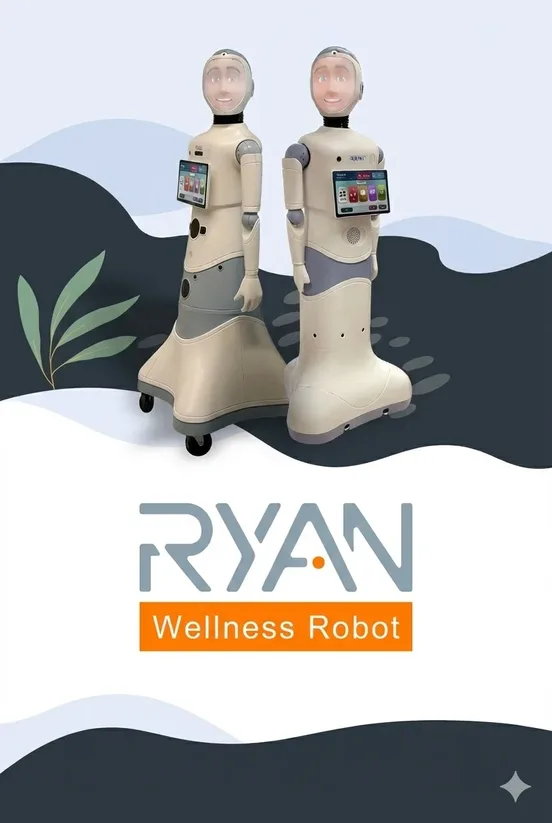
MEET RYAN

AI-Powered Wellness Robot

A research and education platform for Physical AI and Healthcare Human-Robot Interaction

Wellness Robotics

Unlike traditional service robots designed for mechanical or repetitive physical tasks, Wellness Robots represent a convergence of Artificial Intelligence (AI), speech and language processing, and facial recognition. These humanoid systems are engineered for Empathetic Engagement, using natural voice intonations and facial expressions to interact with humans in a manner that simulates personality and expressiveness.

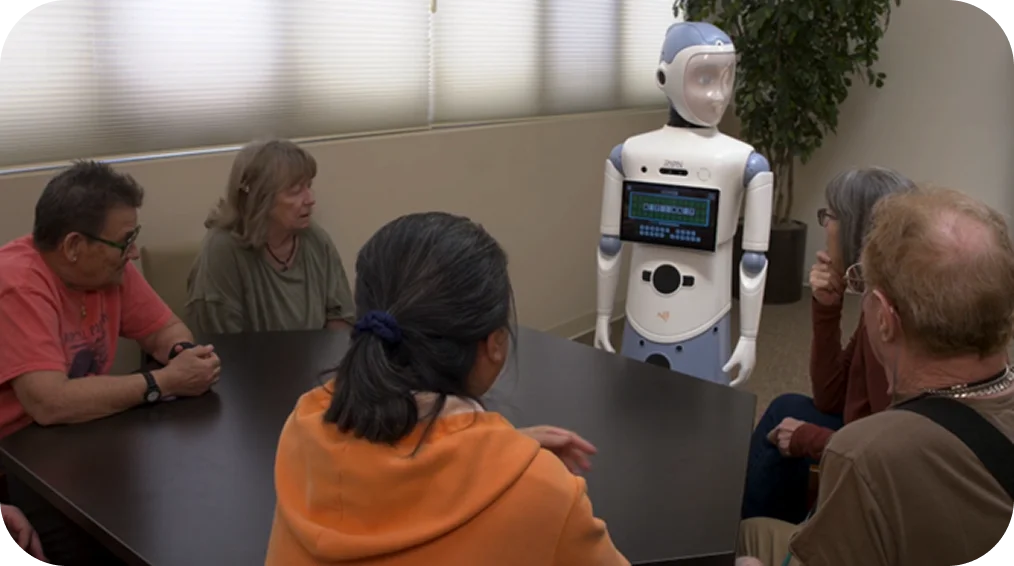
Ryan robot interacting with seniors
Play

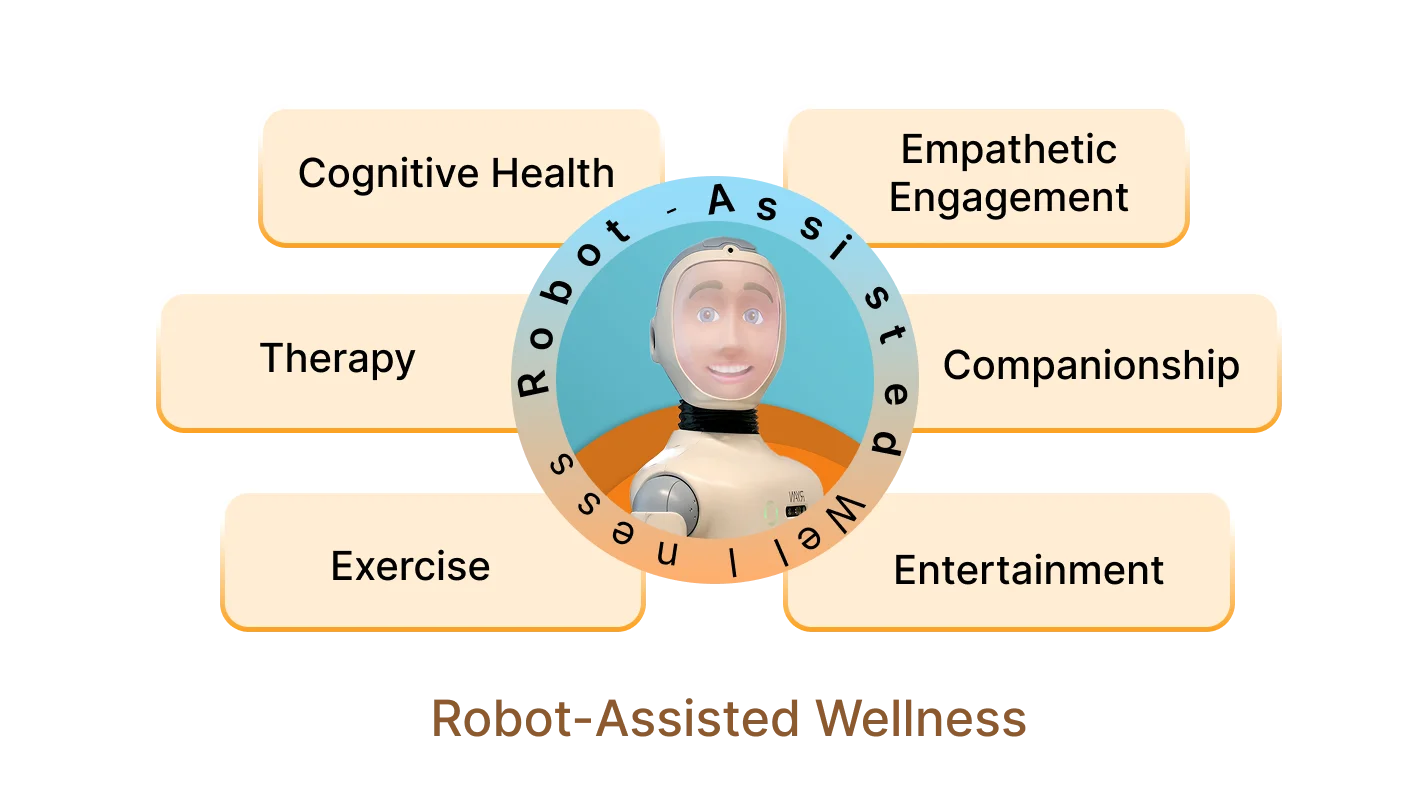
Impact on the 7 Dimensions of Wellness

Robot-Assisted Wellness - Cognitive Health, Empathetic Engagement, Therapy, Companionship, Exercise, Entertainment
The convergence of speech, language, and facial recognition technologies along with artificial intelligence has made it possible for robots to interact naturally with people — giving them something they never had before: an engaging personality.

Technology Architecture

Ryan robot

Artificial Intelligence

RYAN employs multi-modal AI to dynamically adapt conversation strategy, activity selection, and emotional tone based on real-time resident response. Context-aware dialogue management enables sustained, coherent interactions over extended sessions — a requirement for therapeutic and cognitive monitoring applications.

Affective Computing

RYAN serves as a robust platform for investigating emotion recognition and affective feedback loops. Its humanoid face and vocal intonations allow researchers to benchmark multimodal sentiment models against live human interaction data, providing a controllable physical stimulus for studying machine-generated affect.

Natural Language Processing

Advanced speech recognition and language generation enables RYAN to conduct natural, fluent conversations across multiple languages. This multilingual capability is of particular research interest in diverse care populations and cross-cultural HRI studies, removing linguistic barriers common in prior social robot deployments.

Embodied AI & LLMs

As a physical deployment testbed, RYAN moves Large Language Model (LLM) research beyond text-only benchmarks into real-world, embodied contexts. Researchers can examine variables like turn-taking latency and grounded reference during extended, multi-turn dialogues in high-stakes environments like senior care.

Interested in collaborating or evaluating the platform?

Leave your contact to receive technical briefs and research updates.

Clinical & Research Validation

The following table maps RYAN's core capabilities to established evidence streams in social robotics, gerontechnology, and clinical care research — situating this technology within the broader scientific literature.

PAPER TITLE
PRIMARY FOCUS
DATE/SOURCE

A PILOT STUDY ON USING AN INTELLIGENT LIFE-LIKE ROBOT AS A COMPANION FOR ELDERLY INDIVIDUALS WITH DEMENTIA AND DEPRESSION

RESEARCHGATE

Initial feasibility study demonstrating the robot's ability to engage with elderly individuals, resulting in lower stress levels among respondents.

Initial feasibility study demonstrating the robot's ability to engage with elderly individuals, resulting in lower stress levels among respondents.

ARTIFICIAL EMOTIONAL INTELLIGENCE IN SOCIALLY ASSISTIVE ROBOTS FOR OLDER ADULTS: A PILOT STUDY

PMC / NIH

Investigating the effectiveness of the robot's artificial emotional intelligence comparing empathetic vs. non-empathetic versions. Found significant improvement in the mood state of users with both versions.

Investigating the effectiveness of the robot's artificial emotional intelligence comparing empathetic vs. non-empathetic versions. Found significant improvement in the mood state of users with both versions.

DEVELOPMENT OF RYAN COMPANION ROBOT FOR ASSISTING ELDERLY PEOPLE WITH ALZHEIMER'S DISEASE

CLINICALTRIALS.GOV (2021-2022)

Details of a clinical trial designed to measure the impact of the Ryan robot on quality of life, AD symptoms, and caregiver burden over an 8- to 10-week interaction period.

Details of a clinical trial designed to measure the impact of the Ryan robot on quality of life, AD symptoms, and caregiver burden over an 8- to 10-week interaction period.

ROBOT-ADMINISTERED SERIOUS BRAIN GAMES FOR OLDER ADULTS WITH MILD COGNITIVE IMPAIRMENT OR EARLY-STAGE ALZHEIMER'S DISEASE

ALZ & DEMENTIA · 2023

20 participants spent 887 hours with Ryan, playing 12 different cognitive games. Average SLUMS scores improved by 3.3 points and PHQ-9 depression scores improved by 2.43 points.

20 participants spent 887 hours with Ryan, playing 12 different cognitive games. Average SLUMS scores improved by 3.3 points and PHQ-9 depression scores improved by 2.43 points.

A PILOT STUDY ON FACIAL EXPRESSION RECOGNITION ABILITY OF AUTISTIC CHILDREN USING RYAN, A REAR-PROJECTED HUMANOID ROBOT

IEEE RO-MAN · 2018

Six children with ASD and six typically developing children tested facial expression recognition using Ryan. Increasing expression intensity significantly improved recognition accuracy.

Six children with ASD and six typically developing children tested facial expression recognition using Ryan. Increasing expression intensity significantly improved recognition accuracy.

Research Applications & Study
Design Opportunities

🤝

HRI Studies

  • Rapport formation over weeks and months
  • Trust dynamics in care-dependent populations
  • Parasocial relationship formation in older adults
  • Cross-cultural interaction differences
  • Emotional synchrony and mirroring
🧬

Affective Computing

  • Facial expression recognition in older adults
  • Mood inference from speech patterns
  • Adaptive dialogue strategy effectiveness
  • Expressive robot face design validation
  • Real-world affect labeling dataset
⚕️

Healthcare Systems

  • Staff burden reduction measurement
  • Activity participation rate analysis
  • Family satisfaction & perceived care quality
  • Cost-effectiveness modeling at scale
  • Ethical frameworks for robot deployment in care
🔬

Clinical Research

  • Longitudinal cognitive trajectory monitoring
  • Depression screening & intervention efficacy
  • Early delirium detection via BIMS changes
  • Sleep and rest pattern correlations
  • Comparison of robot vs. human-administered assessments