






Book a Demo with Ryan

Ryan in Clinical Studies

Evidence-Based Results

SPONSORS AND COLLABORATORS
$236 BILLION USD

The Value of Research

Americans suffering from Alzheimer's disease (AD) cost the nation $236 billion annually with projected annual costs of over $1 trillion by 2050. Successful development of Ryan will improve older adult well-being, make caregivers more efficient and effective, provide significant financial benefits to the healthcare industry, and assist families and caregivers who are looking for ways to better assist older adults with AD.

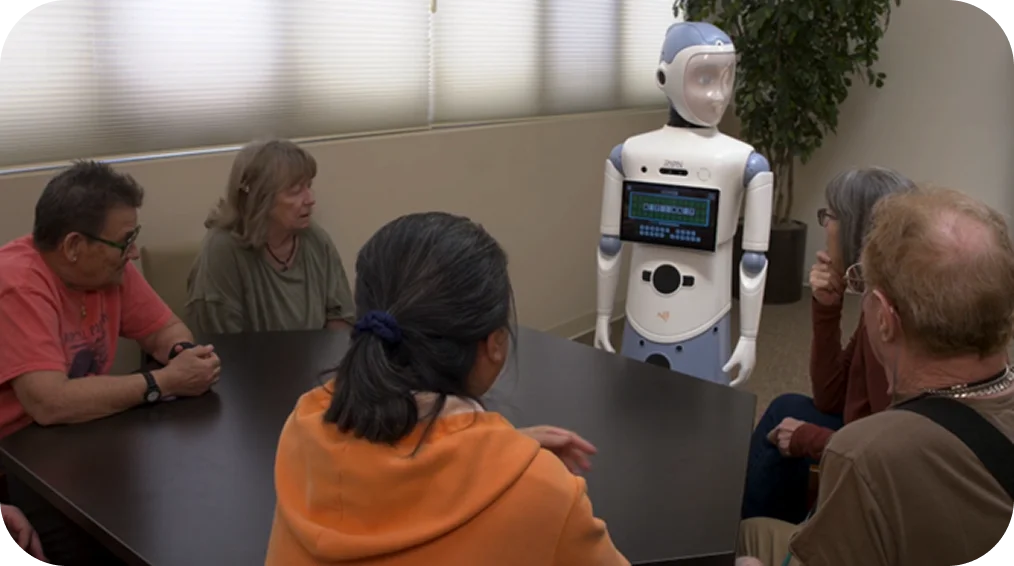
Ryan leading a group session
Empathetic Engagement
Always Caring
Leading Group Activities

Evidence of Efficacy

Participants in our clinical studies spent over 887 hours interacting with Ryan, with significant improvements in cognitive scores (SLUMS) and depression indicators (PHQ-9). Both empathetic and non-empathetic versions of Ryan showed positive effects on mood and engagement, with users finding the emotionally-intelligent Ryan more likable and engaging.

Key Papers and Publications

PAPER TITLE
PRIMARY FOCUS
DATE/SOURCE

A PILOT STUDY ON USING AN INTELLIGENT LIFE-LIKE ROBOT AS A COMPANION FOR ELDERLY INDIVIDUALS WITH DEMENTIA AND DEPRESSION

IEEE HUMANOIDS · 2017

Initial feasibility study with six elderly individuals with moderate dementia/depression in a Denver senior living facility. Each had 24/7 access to Ryan for 4-6 weeks, resulting in lower stress levels.

Initial feasibility study with six elderly individuals with moderate dementia/depression in a Denver senior living facility. Each had 24/7 access to Ryan for 4-6 weeks, resulting in lower stress levels.

ARTIFICIAL EMOTIONAL INTELLIGENCE IN SOCIALLY ASSISTIVE ROBOTS FOR OLDER ADULTS: A PILOT STUDY

PMC / NIH · 2023

Compared empathetic vs. non-empathetic versions of Ryan with 10 older adults. Found significant mood improvement with both versions; users found the emotionally-intelligent Ryan more engaging and likable.

Compared empathetic vs. non-empathetic versions of Ryan with 10 older adults. Found significant mood improvement with both versions; users found the emotionally-intelligent Ryan more engaging and likable.

ROBOT-ADMINISTERED SERIOUS BRAIN GAMES FOR OLDER ADULTS WITH MILD COGNITIVE IMPAIRMENT OR EARLY-STAGE ALZHEIMER'S DISEASE

ALZ & DEMENTIA · 2023

20 participants spent 887 hours with Ryan, playing 12 different cognitive games. Average SLUMS scores improved by 3.3 points and PHQ-9 depression scores improved by 2.43 points.

20 participants spent 887 hours with Ryan, playing 12 different cognitive games. Average SLUMS scores improved by 3.3 points and PHQ-9 depression scores improved by 2.43 points.

DEVELOPMENT OF RYAN COMPANION ROBOT FOR ASSISTING ELDERLY PEOPLE WITH ALZHEIMER'S DISEASE

CLINICALTRIALS.GOV · 2021

Clinical trial measuring Ryan's impact on quality of life, AD symptoms, and depression through blood biomarker analysis over an 8-10 week interaction period.

Clinical trial measuring Ryan's impact on quality of life, AD symptoms, and depression through blood biomarker analysis over an 8-10 week interaction period.

A PILOT STUDY ON FACIAL EXPRESSION RECOGNITION ABILITY OF AUTISTIC CHILDREN USING RYAN, A REAR-PROJECTED HUMANOID ROBOT

IEEE RO-MAN · 2018

Six children with ASD and six typically developing children tested facial expression recognition using Ryan. Increasing expression intensity significantly improved recognition accuracy.

Six children with ASD and six typically developing children tested facial expression recognition using Ryan. Increasing expression intensity significantly improved recognition accuracy.